Partial lunar eclipse tonight offers rare celestial viewing opportunity
 By Priya Raman · · 5 min read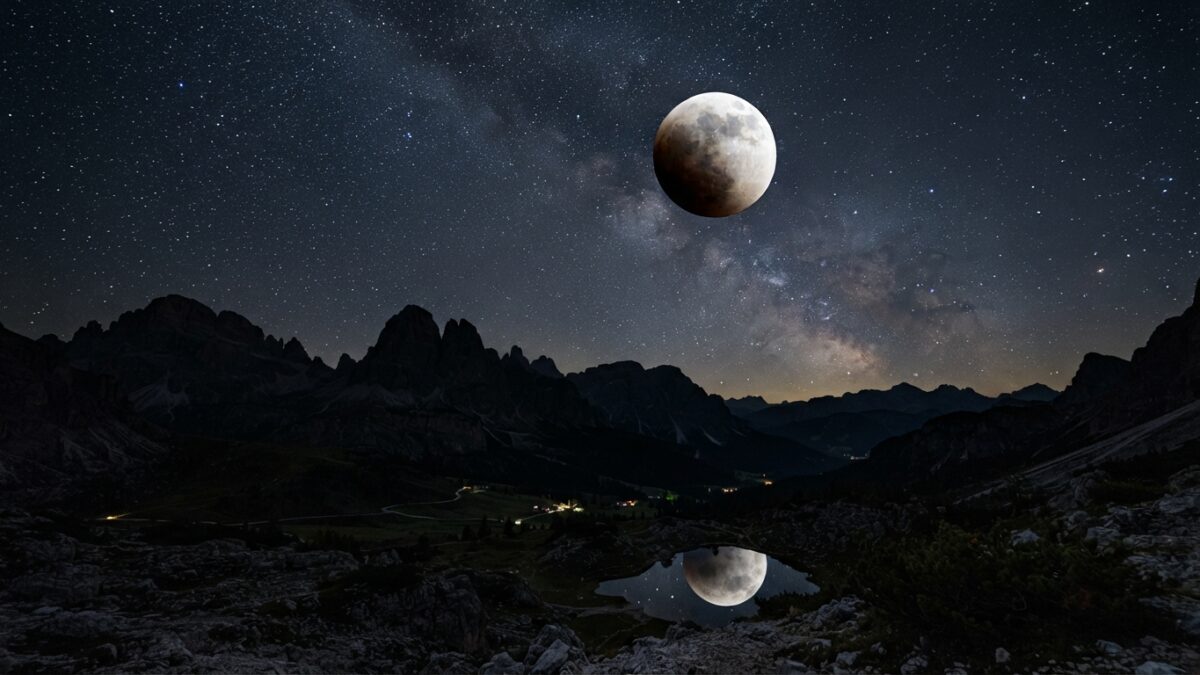
A partial lunar eclipse will be visible across large portions of the globe during the night of August 27-28, offering amateur and professional astronomers alike an opportunity to observe a celestial phenomenon that occurs only a handful of times each year. The event marks one of the year’s most accessible astronomical displays, requiring no special equipment beyond clear skies and a view toward the eastern horizon.
The eclipse will be visible across North America, South America, Europe, Africa, and western Asia, with viewing conditions varying by location. Peak eclipse is expected to occur in the early morning hours of August 28 in most time zones, when the Moon passes through the outer edge of Earth’s shadow, known as the penumbra.
Understanding the mechanics of tonight’s eclipse
During a partial lunar eclipse, the Moon passes through only a portion of Earth’s umbra, the darkest part of its shadow. This differs from a total lunar eclipse, where the Moon is completely immersed in the umbra and often takes on a reddish hue due to sunlight filtering through Earth’s atmosphere. Tonight’s event will see roughly a portion of the lunar surface darkened as it traverses the shadow’s edge.
The eclipse sequence begins when the Moon enters the penumbral shadow, a lighter outer shadow where sunlight is only partially blocked. Observers may notice a subtle dimming on one side of the Moon during this phase. The partial phase begins when the Moon touches the umbra, creating a noticeable dark bite taken from the lunar disk.
Unlike solar eclipses, which require protective eyewear, lunar eclipses are safe to view with the naked eye. The Moon reflects sunlight rather than emitting its own light, making it no more dangerous to observe during an eclipse than on any other night.
Optimal viewing times across major regions
Eastern time zone observers should look skyward between midnight and 3 a.m. on August 28 for the best views. The Moon will be positioned in the southern to southwestern sky during peak eclipse, offering favorable viewing angles for those with unobstructed horizons.
Western regions of North America will see the eclipse begin earlier in the evening of August 27, with mountain and pacific time zones experiencing the event during more accessible evening hours. This timing makes the eclipse particularly favorable for families and educational groups seeking to introduce younger observers to astronomical phenomena.
European observers face a timing advantage, with the eclipse visible in pre-dawn hours that may prove more convenient than middle-of-the-night viewing. Africa and the Middle East will see the event unfold in varying timeframes depending on longitude, with eastern regions catching the eclipse during late night hours and western areas viewing it closer to midnight local time.
What observers can expect to see
The visual characteristics of a partial lunar eclipse differ substantially from total eclipses that produce the dramatic blood moon effect. Tonight’s event will display a graduated shadow crossing the lunar surface, with the darkened portion appearing noticeably dimmer than surrounding areas still in full sunlight.
Binoculars or small telescopes enhance the viewing experience by revealing subtle color variations in the shadowed regions and allowing observation of lunar surface features as they enter and exit the umbra. The contrast between illuminated and shadowed areas becomes particularly striking when viewed through optical aids.
Photography enthusiasts can capture the eclipse using standard camera equipment. Tripod-mounted cameras with telephoto lenses produce the most dramatic results, though even smartphone cameras with manual exposure controls can document the event. The relatively bright nature of a partial eclipse makes it more forgiving for amateur astrophotographers than deep-sky subjects.
Historical context and eclipse frequency
Lunar eclipses occur two to four times annually, though not all are visible from any given location on Earth. The frequency depends on the precise alignment of the Sun, Earth, and Moon, which must fall along a nearly straight line for an eclipse to occur. This alignment happens only when the Moon crosses the ecliptic plane near full moon phase.
The eclipse cycle follows predictable patterns known as the Saros cycle, an 18-year period after which eclipses repeat with similar characteristics. Ancient astronomers identified this pattern millennia ago, enabling prediction of future eclipses with remarkable accuracy using purely observational methods.
Partial eclipses represent the most common type of lunar eclipse, occurring more frequently than either total or penumbral eclipses. Their accessibility and visual appeal make them valuable opportunities for public engagement with astronomy and for educational demonstrations of celestial mechanics.
Scientific value beyond visual spectacle
Professional astronomers use lunar eclipses to study Earth’s atmosphere and to calibrate instruments. As sunlight passes through the atmospheric rim during an eclipse, it carries information about atmospheric composition, aerosol content, and temperature structure. These measurements complement satellite observations and provide validation data for atmospheric models.
Eclipse observations also serve educational purposes, demonstrating fundamental concepts in orbital mechanics and shadow geometry. The predictability of eclipses illustrates the precision of gravitational calculations and validates our understanding of celestial motion developed over centuries of observation and refinement.
Amateur astronomers contribute valuable data through eclipse timing observations, which help refine predictions for future events and occasionally reveal unexpected phenomena such as impact flashes from meteoroids striking the lunar surface during the darkened phase.
Weather outlook and viewing alternatives
Clear skies remain the primary requirement for successful eclipse observation. Observers should check local weather forecasts throughout the day, as conditions can change rapidly. Those facing cloud cover may find clearer skies by traveling relatively short distances to areas with different weather patterns.
Multiple organizations and observatories will provide live streams of the eclipse for those unable to view it directly due to weather, location, or other constraints. These broadcasts often include expert commentary explaining the eclipse mechanics and answering viewer questions in real time.
Future eclipse opportunities will continue at regular intervals, with the next visible lunar eclipse from North America expected in early 2025. Tonight’s event offers immediate access to a phenomenon that has captivated human observers since prehistoric times, requiring nothing more than clear skies and attention to the heavens.